

Founder Section
Founder & President
The Leegard Institute for Education and Leadership
Dr. Claire Leegard is a respected nurse leader, educator, and healthcare entrepreneur dedicated to advancing clinical excellence and developing the next generation of healthcare professionals. With decades of experience spanning patient care, operational leadership, and organizational growth, she brings a rare combination of clinical depth and executive insight to every learning environment.
As the Founder and President of The Leegard Institute, Dr. Leegard created an education platform grounded in real-world application — equipping healthcare professionals with practical strategies that strengthen clinical judgment, elevate patient outcomes, and foster confident leadership.
Throughout her career, Dr. Leegard has been known for building high-performing care teams, mentoring emerging leaders, and championing standards that move healthcare forward. Her teaching style reflects both rigor and relevance, bridging the persistent gap between textbook learning and the complexities of modern care delivery.
In addition to her work in education, Dr. Leegard is an accomplished business owner and operator of multiple healthcare service organizations, giving her a uniquely comprehensive perspective on the continuum of care and the leadership required to sustain excellence within it.
Driven by a deep belief that leadership is a responsibility — not merely a title — Dr. Leegard remains committed to preparing healthcare professionals to lead with competence, integrity, and purpose.
Her vision is clear:
To teach the next generation of healthcare leaders not only how to practice — but how to lead.
The Leegard Model™
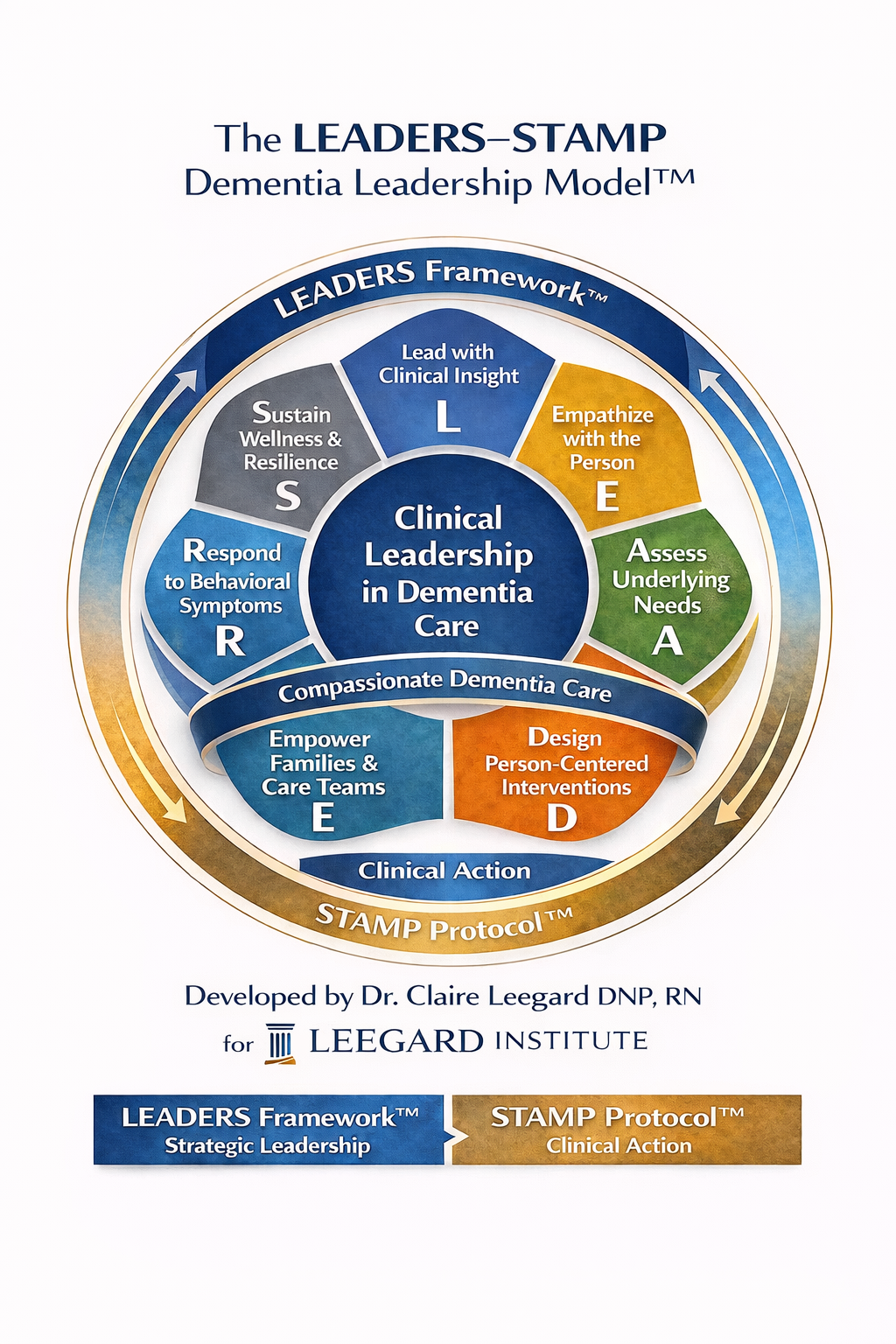
The Leegard Framework™ is a practical leadership-centered model for understanding and responding to dementia-related behaviors in clinical and caregiving environments.
Developed by Dr. Claire Leegard, DNP, RN, founder of The Leegard Institute, the framework bridges the gap between theory and bedside practice. While dementia education often focuses on diagnosis or symptom management, the Leegard Framework™ emphasizes something equally critical: how clinicians think and respond in real time when behaviors emerge.
The model is grounded in a simple but powerful premise:
Dementia-related behaviors are not random disruptions — they are often expressions of neurological change, unmet needs, or environmental stress.
The Leegard Framework™ equips clinicians, nurses, and caregivers with a structured way to interpret those behaviors and respond with clinical insight and compassion.
Most importantly, it is immediately usable. The model is designed for the realities of healthcare environments — long-term care, home care, hospitals, assisted living, and family caregiving — where staff must make decisions quickly and confidently.
The framework combines two complementary tools:
The LEADERS Framework™
and
The STAMP Protocol™
Together they provide both interpretation and action.
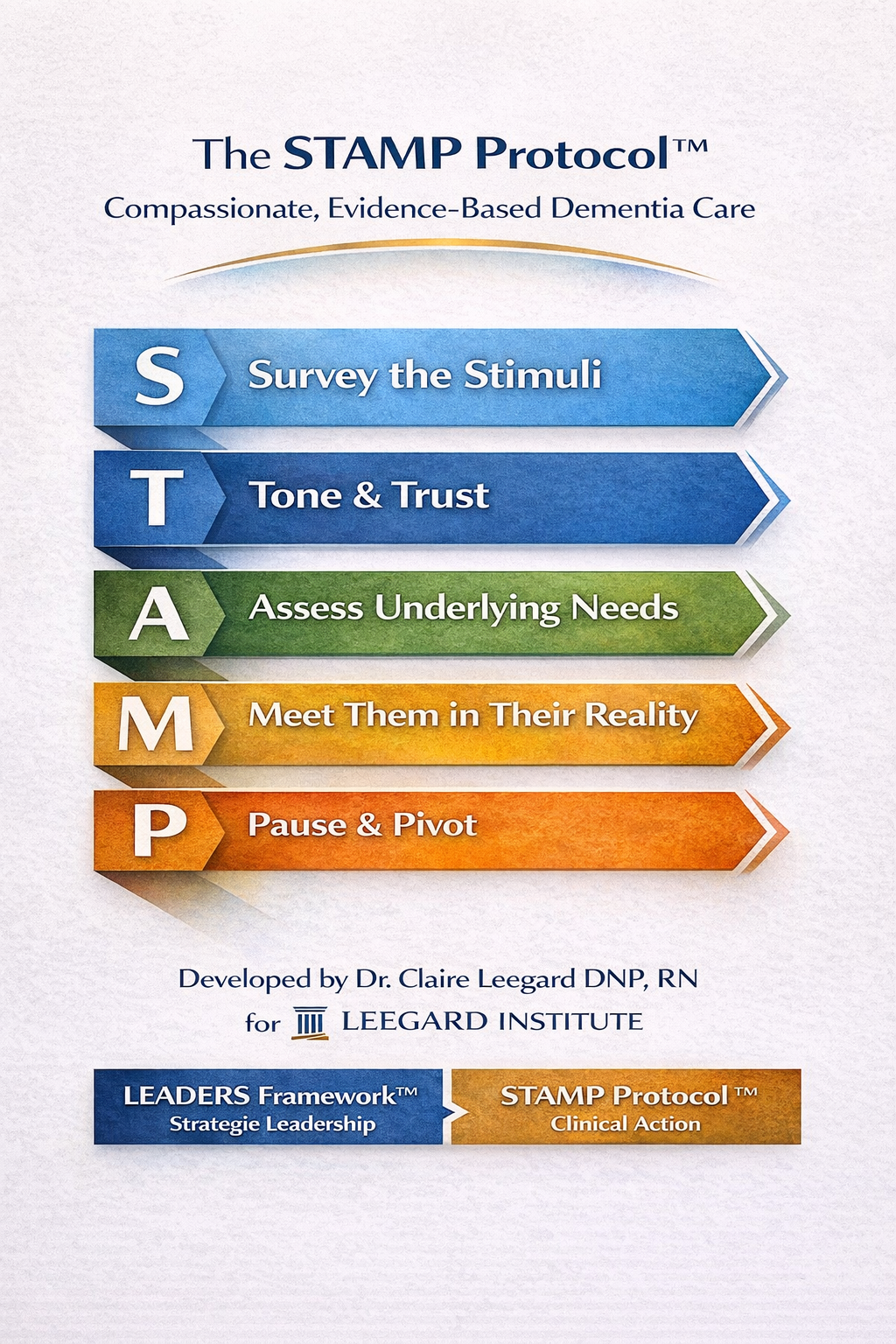
The STAMP Protocol™
If LEADERS helps clinicians understand behavior, the STAMP Protocol™ provides the action steps for responding in the moment.
The STAMP Protocol™ is designed for real-life care situations where caregivers must quickly determine how to respond to agitation, confusion, or distress.
S — Survey the Stimuli
Observe the environment for triggers such as noise, crowding, unfamiliar settings, or sudden changes.
T — Tone & Trust
Approach calmly and respectfully. A caregiver’s tone and body language strongly influence the individual’s response.
A — Assess Needs
Consider unmet needs such as pain, hunger, fatigue, fear, or confusion.
M — Meet Them in Their Reality
Rather than correcting or confronting the individual, acknowledge their experience and redirect gently.
P — Pause & Pivot
Slow down the interaction and redirect toward a safer or more comforting activity.
The STAMP Protocol™ transforms moments of uncertainty into structured, compassionate responses.
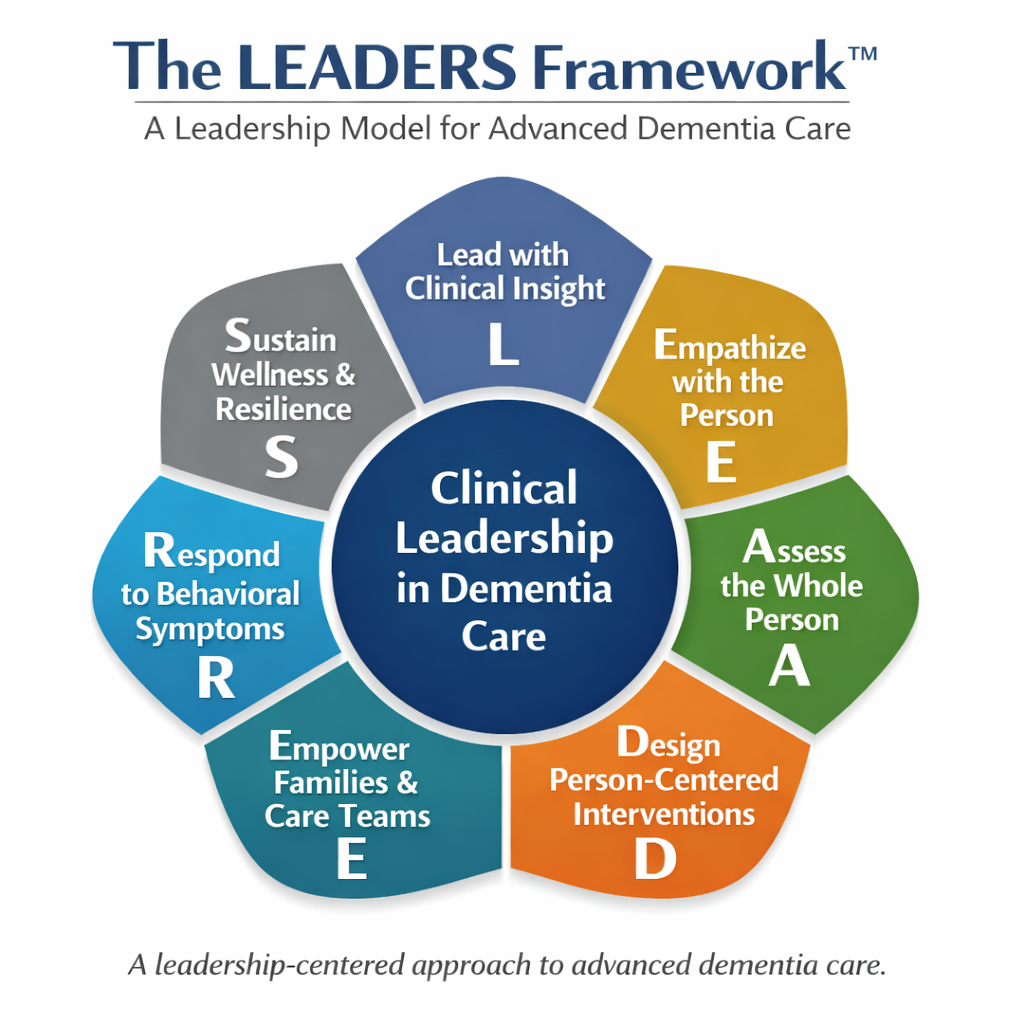
The LEADERS Framework™
The LEADERS Framework™ forms the interpretive foundation of the Leegard Model™. It guides clinicians in understanding what may be driving dementia-related behaviors before reacting to them.
L — Lead with Clinical Insight
Recognize the neurological changes associated with dementia and approach behaviors with clinical understanding rather than frustration.
E — Empathize with the Person
See the individual beyond the diagnosis. Emotional validation helps reduce fear and agitation.
A — Assess the Whole Person
Consider physical, emotional, and environmental factors such as pain, fatigue, noise, hunger, or unfamiliar surroundings.
D — Design Person-Centered Interventions
Adjust care approaches to match the individual’s cognitive abilities and personal history.
E — Empower Families and Care Teams
Dementia care is collaborative. Families and interdisciplinary teams play a vital role in supporting the individual.
R — Respond to Behavioral Symptoms
Interpret behaviors as meaningful signals rather than problems to eliminate.
S — Sustain Wellness and Resilience
Support both the person living with dementia and the caregivers providing care.
The LEADERS Framework™ shifts the clinician’s mindset from managing behavior to understanding behavior.
The Power of the Model
The strength of The Leegard Model™ lies in its integration of clinical interpretation and practical action.
LEADERS provides the lens.
STAMP provides the response.
Together, they create a model that is:
• practical
• immediately usable
• grounded in real dementia care environments
• applicable across multiple healthcare settings
Through this approach, clinicians are empowered not only to manage behaviors, but to practice leadership-centered dementia care.